
Rubber Track Guide: Measurements, Symbols and Maintenance
A rubber track dimension is always expressed as Width × Pitch × Number of Links (e.g. 230×72×43). This guide explains how to take these 3 measurements, decode the letters that sometimes follow them, and maintain your undercarriage to extend its lifespan. Want to understand the technology first? Check out our page on the history and applications of rubber tracks.
How to measure your rubber track
Follow these 3 simple steps to identify the exact dimension of your rubber track.
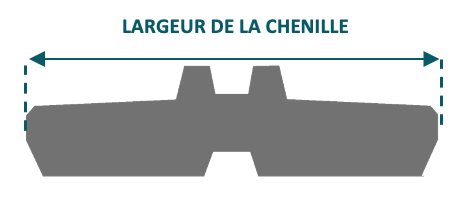
The Width
Measure the overall width of the rubber track in millimetres.
Example: 230 mm
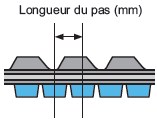
The Pitch
Measure the centre-to-centre distance between two links.
Example: 72 mm
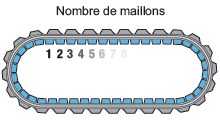
The Links
Count the total number of metal teeth on the inside of the rubber track.
Example: 43 links
Measuring a worn or destroyed rubber track
If your rubber track is too damaged to measure precisely, two solutions can help you find the exact reference:
- The engraved reference: a marking is moulded into the inner side of the rubber track (e.g. 230x72x43). It remains legible even when the outer rubber is heavily worn, except in the event of complete tearing.
- Counting on the undercarriage: if no marking is legible, count the number of teeth on the sprocket (drive wheel): this generally matches the pitch of the original rubber track. Combined with the undercarriage width, this helps identify the compatible dimension.
If in doubt, contact our experts with a photo of the rubber track and undercarriage: we will identify the correct reference from these details.
What do the letters after the size mean?
A letter often follows your dimension (e.g. 300x52.5x80 N). Here's how to interpret them:
Guide type
N (Narrow): Narrow guide. The inner guide link is thinner.
W (Wide): Wide guide system for undercarriages requiring a larger footprint.
Rail profile
B: Specific rail (often with raised rubber).
T (T-Guide): Reinforced rail for specific rollers (common on Takeuchi/Gehl).
Technology
J (Jointless): Continuous steel cord with no weld to prevent breakage.
K / KW: Guide variants for outer-flange rollers.
| Lug Profile | Name | Ideal Use |
|---|---|---|
| C-Lug | "C" Profile | All-round versatility, excellent traction in mud and soil. |
| Zig-Zag | Staircase / Z | Best self-cleaning on very greasy ground or snow. |
| Multi-bar | Fine bars | Reduces vibration on hard surfaces (asphalt, concrete). |
| Hex | Hexagonal | Landscaping: protects lawns and minimises ground marking. |
Interchangeable or specific linkage?
Beyond the dimension letters, the alignment of the rollers on the undercarriage also determines compatibility:
- Interchangeable linkage (Conventional): the rollers run along the centre of the rubber track, on a simple, symmetrical link. This is the most common format, compatible with several equivalent undercarriage brands.
- Specific linkage: the rollers are positioned at the edges (outer flanges) or require a manufacturer-specific guide profile (see letters K/KW above). These rubber tracks are only compatible with the undercarriage they were designed for.
The J technology (continuous steel cord with no weld) can be applied to both linkage types: it concerns the internal strength of the rubber track, not its alignment on the undercarriage. To understand how it works in detail, check out our page on the innovation of continuous steel cord.
Short or long pitch: what's the difference?
For the same width, a rubber track sometimes comes in several pitches — the centre-to-centre distance measured in step 2 above. A 300 mm track, for example, is available with a 52.5 mm or 109 mm pitch. On most mini excavators, both versions remain compatible with the same sprocket and rollers: the choice therefore mainly depends on your intended use.
Short pitch (e.g. 52.5 mm)
More links over the same length: a more flexible rubber track, offering better adaptability on uneven ground and in tight manoeuvres. Force is better distributed on the sprocket, resulting in less vibration when driving. Slightly more frequent maintenance required.
Long pitch (e.g. 109 mm)
Fewer, but more robust links: better mechanical strength and stability on flat ground or under heavy load. Fewer contact points subject to wear. A single replacement link is more expensive in the event of breakage.
In summary: choose a short-pitch rubber track for manoeuvrability on rough terrain or in tight spaces, and a long-pitch rubber track for stability and durability on flat ground or under heavy loads. Not sure which pitch is compatible with your machine? Measure the width, pitch and number of links as described in step 2.
You can also contact our technical team to confirm the dimension matching your machine and application.
5 Tips to extend the life of your rubber tracks
1. Check the tension: A rubber track that is too tight wears the rollers prematurely. If too loose, it risks derailing and damaging the steel guides.
2. Daily cleaning: Dried soil acts like sandpaper. Rinsing with water after the job site extends the undercarriage's lifespan considerably.
3. Avoid pivoting on the spot: Sharp turns on asphalt or concrete are the leading cause of rubber tearing.
4. Drive forward: Try to limit prolonged reversing, which places extra strain on the links and sprocket.
5. Sheltered storage: Protect the rubber tracks from prolonged UV exposure and standing mud during extended machine downtime.
Should rubber tracks be replaced as a pair or individually?
Even if only one rubber track is visibly more worn, we recommend always replacing both sides together:
- Even wear and traction on both sides of the machine.
- Less strain on the rollers, idlers and sprockets of the undercarriage.
- Preserved lifespan of the new rubber track, which would otherwise absorb a disproportionate share of the load next to a worn track and wear out faster than it should.
- More predictable handling, particularly on slopes or side gradients.
- Long-term savings: the initial investment is higher, but replacing the pair prevents further damage and frequent repairs to the undercarriage.
Find your reference in 2 clicks
With your measurements to hand, find your rubber track directly through our selector:
Not sure about your reference?
Our construction machinery experts identify your rubber track from a photo or the engraved number.
Once you've taken your measurements, use our selector to order without errors.
Back to the selector